
AccountTech makes a bold bet on private ai for accounting
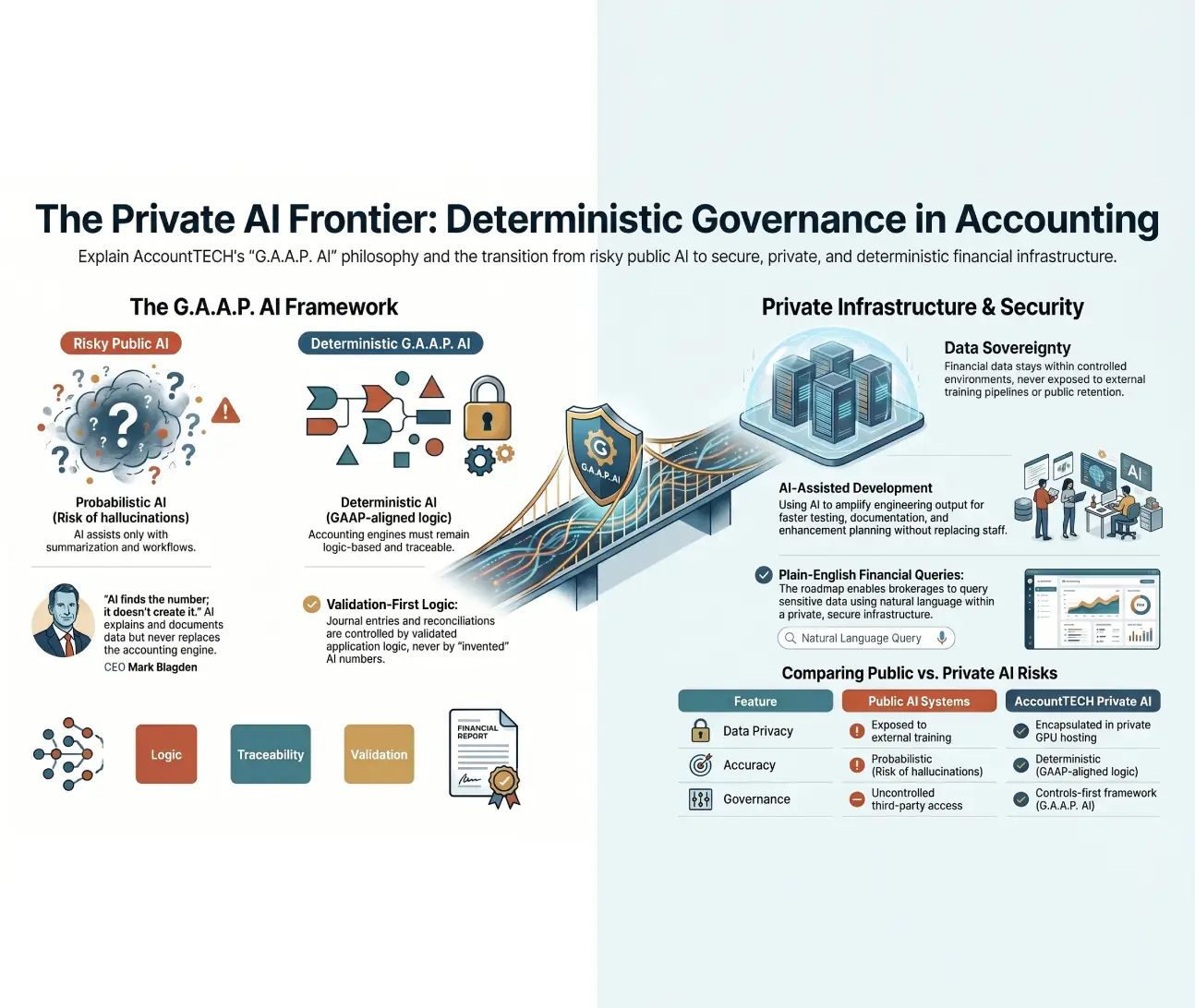
the ai race in software has created a dangerous pattern across the industry: companies rushing to add chatbots and generative ai features without fully addressing compliance, auditability, or data governance.
for accounting software providers, that approach creates enormous risk.
this week, AccountTECH announced a major investment in private AI infrastructure designed specifically for accounting and real estate brokerage operations — including enterprise gpu hardware, private model hosting, ai-assisted development workflows, and a controls-first AI framework called G.A.A.P. AI.
unlike consumer ai platforms that prioritize conversational fluency, AccountTECH’s strategy is built around deterministic accounting systems, auditability, and client data protection.
what is G.A.A.P. AI?
at the center of the initiative is AccountTECH’s internally developed G.A.A.P. AI framework.
the philosophy is simple:
ai may assist accounting workflows — but ai should never become the accounting engine itself.
under the framework:
- accounting calculations remain deterministic and traceable
- financial reporting stays GAAP-aligned.
- journal entries and reconciliations remain controlled by validated application logic
- ai assists with explanation, classification, summarization, and workflow acceleration
this distinction matters because large language models are probabilistic by nature. they generate responses that sound convincing even when incorrect — a dangerous reality in financial environments where accuracy is non-negotiable.
as mark blagden, ceo of AccountTECH, explained:
"AI can help you find a number, explain it, document it, maybe even help reconcile it — but the moment AI starts inventing numbers is the moment we stop being an accounting company.”
why private ai matters
AccountTECH’s investment also reflects growing concerns around public AI tools and sensitive financial data.
across industries, employees increasingly paste budgets, general ledger details, payroll information, commission statements, and strategic planning documents into public AI systems without fully understanding the associated risks.
AccountTECH’s position is that financial data should remain within controlled environments.
the company’s private AI strategy aims to ensure that brokerage financial information is never exposed to public model retention, external training pipelines, or uncontrolled third-party systems.
ai-assisted development without replacing developers
the investment is already transforming how AccountTECH develops software internally.
AI-assisted workflows are now helping with:
- enhancement planning
- automated testing
- documentation generation
- database change summaries
- training content creation
interestingly, the company is not positioning ai as a replacement for engineering staff.
instead, the goal is to amplify developer productivity and allow non-programming staff to contribute more directly to enhancement workflows using AI-assisted tooling.
according to AccountTECH, the targeted outcome is a smaller engineering team producing the output of a much larger one — while improving documentation consistency and test coverage.
what’s coming next
the roadmap extends well beyond internal development tools.
future initiatives include:
- private client ai chat interfaces
- client-driven report generation
- ai-assisted dashboard creation
- firm-specific rag-powered knowledge systems
- searchable ai-powered training libraries
one of the most ambitious goals is enabling brokerages to query their own financial data using plain-english questions while keeping all sensitive information within AccountTECH-controlled infrastructure.
a different philosophy on AI
many software companies are treating AI as a feature layer.
AccountTECH appears to be treating AI as infrastructure.
that distinction may become increasingly important as accounting firms, brokerages, and finance teams begin asking harder questions about compliance, auditability, privacy, and governance in AI-powered systems.
for AccountTECH, the message is clear:
the future of AI in accounting must remain private, deterministic, auditable, and controlled.
ready to evolve?
request a demo or learn more about the power of darwin.Cloud