compare brokerage accounting software

Compare darwin.Cloud, Lone Wolf Back Office, BoldTrail BackOffice, and QuickBooks-based workflows on commissions, escrow or trust, agent billing and payments, financial reporting, integrations, and accounting services. Start with the work your brokerage must complete, then test the details behind each feature claim.

darwin.Cloud / accounting
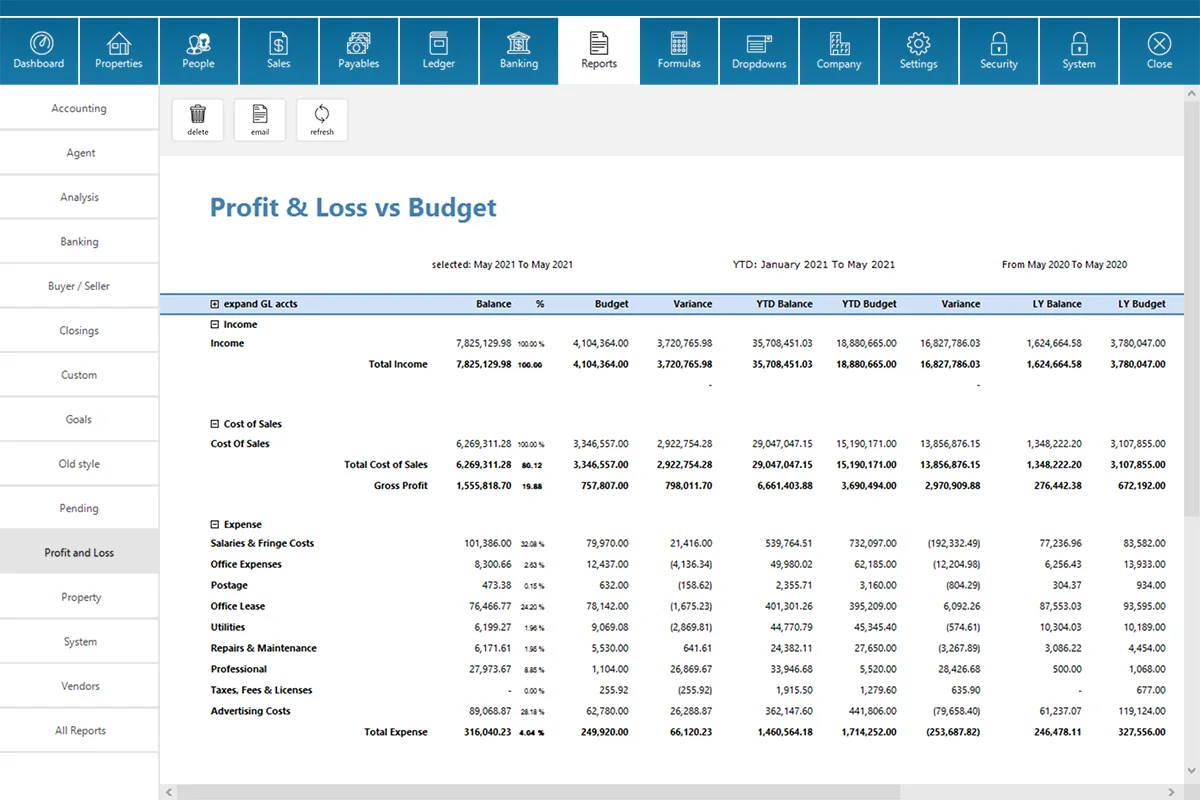
darwin.Cloud real estate brokerage accounting dashboard

the short answer

which option fits your brokerage?

darwin.Cloud is worth shortlisting when your brokerage wants commissions, escrow or trust, agent billing, and financial reporting in one system, with optional AccountTECH accounting services. Lone Wolf also documents native brokerage accounting and has a clearer documented fit for Canadian payroll requirements. BoldTrail documents commission, transaction, and billing tools with QuickBooks integration. QuickBooks-based workflows remain an option when general bookkeeping fits your needs and brokerage-specific processes are separately validated. [1][5][6][8][9][10]

This comparison is published by AccountTECH, the company behind darwin.Cloud. It uses the vendors' published information and identifies details that buyers should verify in a demonstration or written quote.

Sources reviewed October 7, 2026. Confirm package scope, pricing, and local requirements with each provider.

four approaches, one buying decision

compare brokerage accounting workflows

Read the documented scope, not just a yes-or-no feature check. Choose a provider on a phone, or view all four side by side on a larger screen.

compare brokerage accounting workflows. Read the documented scope, not just a yes-or-no feature check. Choose a provider on a phone, or view all four side by side on a larger screen.
buying criteriondarwin.Cloud
commission automationDocuments complex splits, caps, overrides, deductions, team plans, and connected commission accounting. [1][2]
general ledger connectionAccounting, commissions, agents, vendors, banking, and multi-company financials share the platform. [1][2]
escrow or trust accountingDocuments escrow or trust banking, reconciliation, journal entries, audit trails, and transaction-level history. [2]
agent billing and paymentsDocuments agent billing, commission deductions, ACH or check payments, and integrated merchant-service workflows. [2]
financial reportingDocuments P&L, cash flow, budgets, trial-balance detail, financial and production analysis, multi-company views, role-specific dashboards, and scheduled delivery. [3]
integrationsDocuments transaction, MLS, franchise, earnest-money, relocation, CRM, and other partner connections, plus a REST API and feed engine. Specific flows vary by partner. [4]
optional human accounting servicesAccountTECH offers full or partial outsourced brokerage accounting, including a model where the brokerage retains closings and selected functions handled à la carte. Scope must be agreed separately. [5]
pricing and commercial scopePublic starting software price is $525/month, based on agent count, with software setup included. Do not assume outsourced services, payment fees, or every migration requirement is included. [14]

How to read this table. A documented capability is not a guarantee that every plan includes it. “Not established” means the reviewed sources did not confirm the scope. It does not mean the provider lacks the capability.

look beyond the feature list

compare the work behind each claim

A feature label is only the starting point. Test the full workflow, including exceptions, corrections, and the accounting result.

01commission automation

A commission calculator is useful only if it applies the brokerage's agreements correctly and produces the accounting and payment records staff need. Show a representative split, cap crossing, team allocation, referral fee, deduction, and correction. Compare who reviews the calculation and how changes affect the ledger and agent statement. darwin.Cloud, Lone Wolf, and BoldTrail all document commission automation. [1][6][8]

02escrow or trust accounting

Separate recording deposits from proving control over client money. Ask each vendor to demonstrate transaction-level balances, deposits, disbursements, reconciliation, permissions, and audit history. Where required, ask for a three-way reconciliation demonstration between the bank statement, book balance, and client or transaction ledgers. Treat this as a buyer requirement to verify, not a capability proven for every product. Confirm the workflow against your jurisdiction’s requirements.

03agent billing and payments

Distinguish collecting agent charges from paying earned commissions. Validate recurring fees, deductions, statements, credits, failed collections, payout authorization, and payment cutoffs. Merchant-service enrollment, processing fees, banking arrangements, and funding timing belong in the commercial evaluation.

04financial reporting

Use the same reporting request across vendors. Request a brokerage P&L, office comparison, agent production view, pending-cash view, and consolidated report where relevant. Trace a number back to its source record. "Has reporting" does not establish the required dimensions, permissions, or reconciliation quality.

05integrations

Use AccountTECH's named integrations only with their documented direction and scope. For example, its page describes Dotloop transaction imports, SkySlope property and contact feeds, and franchise-reporting connections. A partner name alone does not prove two-way synchronization of every field. Request record matching, cadence, error handling, and support ownership for every shortlisted product. [4]

06optional outsourced services

Separate software automation from work performed by accountants. AccountTECH's "we do everything," "you do the closings," and à la carte options describe different task allocations. "What you do" explains retained brokerage responsibilities. Confirm the commercial scope in writing. Compare who approves closings, moves money, pays bills, reconciles banks, and completes month-end, not only whether human help exists. [5]

choose for your operating model

a shortlist, not a universal winner

The right choice depends on who does the accounting, which workflows must stay connected, and what your existing setup already handles.

shortlist darwin.Cloud when

  • The brokerage wants commission accounting, escrow or trust, agent billing, payments, and reporting connected in one brokerage platform. [1][2]
  • Finance and operations need financial and production views across companies or offices. [3]
  • Its required systems fit AccountTECH's documented connections or a scoped integration project. [4]
  • It wants the option to move agreed accounting work to AccountTECH rather than only buy software. [5]

consider Lone Wolf Back Office when

Native Canadian payroll is a reason to consider Lone Wolf. Lone Wolf expressly documents Canadian staff and agent payroll, T4 workflows, and Canadian compliance functions. The AccountTECH sources reviewed do not establish equivalent native Canadian staff-payroll coverage; T4A preparation is not the same capability. [6][14]

Lone Wolf also documents native accounting, commissions, trust or escrow, and reporting. A brokerage already invested in its ecosystem should test whether those existing connections make staying the better operating decision. [6]

consider BoldTrail BackOffice when

The brokerage prioritizes transaction management alongside commission automation, agent billing, ACH disbursements, and agent workflows, or specifically wants to evaluate its documented QuickBooks connection. Validate the boundary between its native accounting tools and connected accounting before replacing your current accounting setup. [8][9]

consider retaining a QuickBooks-based workflow when

General bookkeeping meets the brokerage's requirements, existing accounting collaboration works, and separate commission and trust processes are reliable enough for its operating model. Intuit documents accountant access, financial reporting, bank feeds, and an app ecosystem. That is a legitimate starting point, not proof that it satisfies every brokerage requirement. [10]

darwin.Cloud may not be the right next step when

  • The buyer only needs personal bookkeeping or a rental-property ledger rather than a brokerage back office.
  • The present system meets the requirements and switching cost or disruption outweighs demonstrated operational benefits.
  • A mandatory integration, jurisdiction-specific workflow, report, or migration requirement has not been validated.
  • The buyer expects property-management functions, native employee payroll, or other workflows not established by the AccountTECH evidence used here.

questions worth resolving

make the demo answer real objections

QuickBooks already works for us.

A working system is a reason to evaluate carefully, not a reason to switch automatically. Compare the complete commission-to-ledger process, trust controls, and reporting needs before changing it.

Ask to see. Intuit's documented general accounting capabilities; a timed workflow comparison using the brokerage's own examples. [10]

every vendor says it automates commissions.

Ask each vendor to run the same cap crossing, team split, fee, deduction, and correction. Compare the final statement, payment record, and ledger entry, not the feature label.

Ask to see. Commission automation is documented by all three specialist platforms. [1][6][8]

we cannot risk our escrow or trust balances.

Validate opening balances, transaction-level detail, access, reconciliation, and audit history before any cutover. Ask your finance and compliance advisers to assess the requirements.

Ask to see. Demonstrated controls and an agreed reconciliation and acceptance process. Product marketing alone is insufficient.

switching will lose our history or disrupt closings.

AccountTECH documents migration of supported historical P&Ls, transaction detail, production, rosters, vendors, and escrow or trust banking records. The exact scope and timing need a written transition plan.

Ask to see. Representative migrated records, balance checks, exceptions, training needs, and cutover ownership. [1][14]

your subscription costs more.

Compare the scoped cost of software, implementation, payment processing, integrations, services, and retained staff work. A lower headline subscription does not establish the lower total cost.

Ask to see. Like-for-like quotes and the buyer's own workload. Compare actual staff time and costs rather than assumed savings.

we do not want to replace our transaction tools.

AccountTECH documents connections to transaction platforms and other brokerage systems. Confirm your specific fields, direction, cadence, and error ownership; no vendor logo proves complete coverage.

Ask to see. Integration specification and a tested sample transaction. [4]

outsourcing means losing control.

AccountTECH offers different allocations of accounting work. Define approvals, access, retained tasks, exceptions, and reporting in the service agreement. Buying software does not automatically outsource the books.

Ask to see. Service task allocation and the responsibilities retained by the brokerage. [5]

test one transaction, end to end

Use one representative transaction as a common test across vendors. Include the buyer's real commission rules, a trust deposit where applicable, an agent charge, a correction, a payout, and the resulting ledger and reports. Mark which steps are automated, configured, performed in another system, or completed by a person.

compare written quotes, not headline prices

Ask each provider to itemize the same scope before comparing total cost.

  • The software edition, agents, users, entities, offices, and any minimums.
  • Setup, migration scope, historical periods, training, and support.
  • Payment enrollment, processing fees, funding timing, and failed-payment handling.
  • Integrations, third-party licenses, API scope, and ongoing maintenance.
  • Optional accounting services and retained brokerage responsibilities.
  • Renewal terms, data exports, and termination arrangements.

AccountTECH’s reviewed public starting software price was $525 per month, based on agent count, with software setup included. Confirm payment fees, migration, and accounting-service scope separately. [14]

brokerage accounting questions

Direct answers to the questions that change a buying decision, with sources you can check.

what is the best accounting software for a real estate brokerage?

The best fit depends on commission rules, escrow or trust requirements, reporting, integrations, and staffing. darwin.Cloud and Lone Wolf document native brokerage accounting. BoldTrail documents brokerage workflows and QuickBooks integration. QuickBooks provides general accounting and connected apps. Compare the same real transactions and reports before selecting a system.

is darwin.Cloud better than Lone Wolf Back Office?

Neither product is universally better. Both document brokerage accounting, commissions, trust or escrow, and reporting. darwin.Cloud also has optional AccountTECH accounting services. Lone Wolf explicitly documents native Canadian payroll. The right choice depends on required workflows, integrations, geography, service scope, and commercial terms.

sources [1][5][6]
what is the difference between darwin.Cloud and BoldTrail BackOffice?

darwin.Cloud documents connected brokerage accounting, commissions, trust, and financial reporting. BoldTrail BackOffice, the next generation of Brokermint, documents transaction management, commissions, billing, ledgers, reporting, and QuickBooks integration. Confirm which accounting and reconciliation tasks run natively in BoldTrail versus a connected system.

sources [1][2][8][9]
can darwin.Cloud replace QuickBooks for a brokerage?

darwin.Cloud is designed to run brokerage accounting alongside commissions, agent billing, payments, and escrow or trust workflows. It can be evaluated as a replacement for a separate general-bookkeeping system. Replacement depends on validating your chart of accounts, reports, integrations, historical records, and any work outside the documented brokerage scope.

sources [1][2][14]
does QuickBooks calculate real estate commission splits and caps?

The reviewed Intuit sources document general accounting and commission-income tracking, but do not establish native brokerage cap, override, and team-plan automation. A QuickBooks-based workflow may use configuration or another application. Buyers should identify the actual calculation method and test its ledger and payment connection.

sources [10][13]
which options support escrow or trust accounting?

darwin.Cloud and Lone Wolf expressly document escrow or trust accounting and reconciliation. Dedicated trust scope was not established by the reviewed BoldTrail pages. QuickBooks documents deposit liability tracking, which is not equivalent evidence of an end-to-end brokerage trust workflow. Validate jurisdiction-specific controls and reconciliation with every vendor.

can brokerage accounting software bill agents and pay commissions?

Yes. darwin.Cloud documents billing, commission deductions, and ACH or check payments. Lone Wolf documents automated agent billing and payouts. BoldTrail documents automated billing and next-day ACH disbursements. Confirm enrollment, payment methods, approval controls, fees, cutoffs, and exceptions rather than assume identical payment terms.

sources [2][7][8][9]
which platform has the financial reports our brokerage needs?

darwin.Cloud, Lone Wolf, BoldTrail, and QuickBooks all document reporting, but their documented dimensions and package scope differ. Request your specific P&L, cash-flow view, agent production report, office comparison, and consolidated report from each vendor. Confirm source data, permissions, exports, and scheduled delivery.

will darwin.Cloud work with our existing transaction platform?

AccountTECH documents connections to platforms including Dotloop and SkySlope, plus franchise and other partner systems. The exact fields, direction, cadence, and connection scope depend on the partner. Confirm your workflow with AccountTECH; a documented integration does not mean every field synchronizes both ways.

sources [4]
can we outsource accounting instead of hiring another back-office employee?

AccountTECH offers full or partial outsourced brokerage accounting powered by darwin.Cloud, including options to retain closings or outsource selected functions. Intuit also offers bookkeeping services, but its reviewed overview does not establish equivalent brokerage closing, payout, or trust-operation coverage. Compare the work performed and the responsibilities retained.

sources [5][12]
which accounting option is cheaper?

No like-for-like evidence establishes the cheapest option for your brokerage. AccountTECH publishes darwin.Cloud starting at $525 per month based on agent count, with software setup included. Compare package-specific subscriptions, migration, integrations, processing fees, accounting services, and retained staff work using current written quotes.

sources [14]
who should choose an alternative to darwin.Cloud?

Lone Wolf deserves consideration for documented native Canadian payroll needs. BoldTrail fits a shortlist emphasizing transaction and agent workflows with QuickBooks connectivity. Retaining QuickBooks may be reasonable when general accounting meets the brokerage's needs and separate processes are validated. Do not switch solely because another product lists more features.

can darwin.Cloud replace our current back-office platform without losing history?

AccountTECH documents migration of supported financial and operating history, but that is not a guarantee that every field from every system will transfer. Agree on source records, historical periods, mapping, reconciliation, exclusions, and access before switching. Ask to validate representative migrated records and opening balances.

sources [1][14]

put the shortlist to work

see your brokerage’s workflow in darwin.Cloud

Bring a representative commission plan, a month-end reporting requirement, and the systems your team needs to keep. Ask AccountTECH to show the full workflow and confirm the software and service scope in writing.